



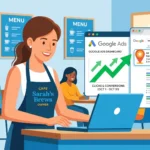
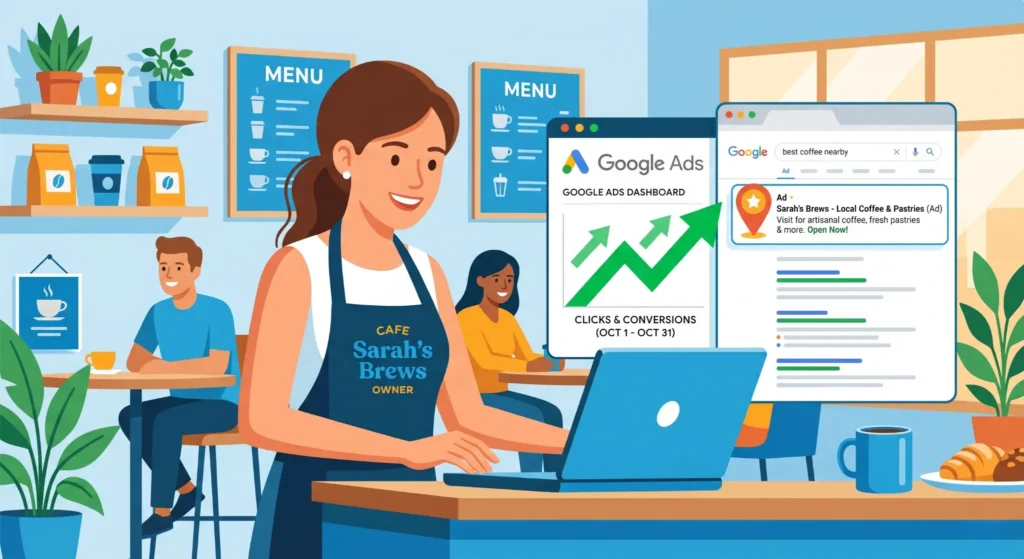
Last year, a small clothing boutique owner told me she’d been waiting for customers to “find her organically” for two years. She was posting on Facebook, keeping her website updated, and hoping Google would eventually rank her. Sales were flat.
Three weeks after launching her first Google Ads campaign, she had more inquiries in a single week than in the previous three months combined.
That’s not a fluke. It’s how Google Ads works it puts your business directly in front of people who are already searching for exactly what you sell.
In this guide, I’ll break down exactly why Google Ads is one of the smartest investments a small business can make right now, what it actually costs, and how to start without wasting money.
What Is Google Ads and How Does It Work?
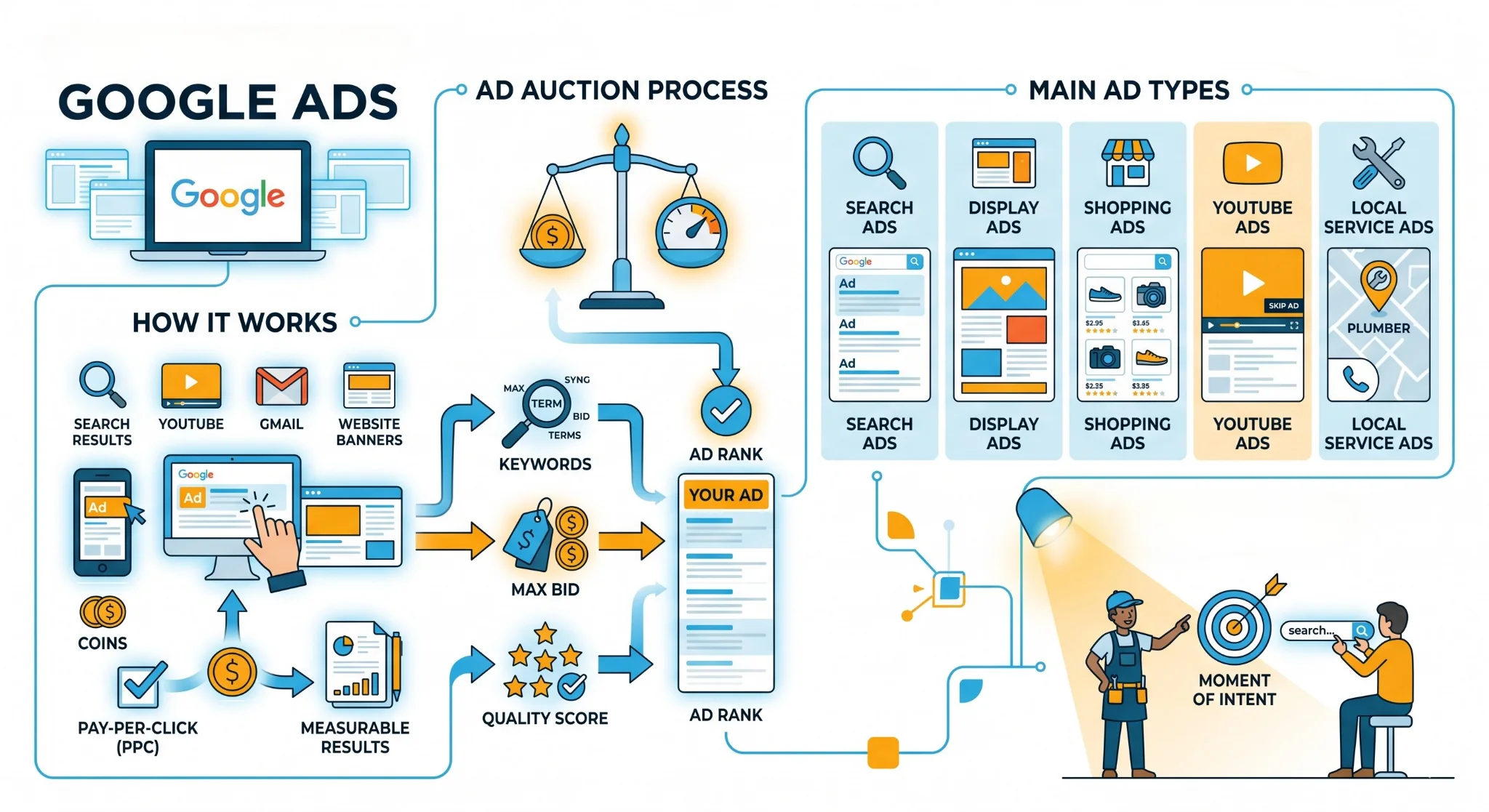
Google Ads is Google’s online advertising platform that lets businesses show paid ads on Google search results, YouTube, Gmail, and millions of partner websites. When someone types a search query related to your product or service, your ad can appear at the very top of the results page above every organic listing.
Here’s the thing: you only pay when someone actually clicks your ad. That’s called pay-per-click (PPC) advertising, and it’s one of the most measurable forms of digital marketing ever invented.
The system works through an auction. You choose keywords the search terms you want to trigger your ad and set a maximum bid for each click. Google then factors in your bid, your Quality Score (relevance of your ad and landing page), and your expected click-through rate to decide where your ad appears.
The Main Ad Types You Should Know.
There are several ad formats available:
- Search Ads — Text ads that appear in Google search results when someone searches for your keywords
- Display Ads — Visual banner ads shown across millions of websites in the Google Display Network
- Shopping Ads — Product listings with images and prices, great for e-commerce
- YouTube Ads — Video ads shown before or during YouTube content
- Local Service Ads — Appear for location-based searches like “plumber near me” or “salon in USA”
For most small businesses just getting started, Search Ads are the right entry point. They catch people at the exact moment of intent when they’re actively looking for what you offer.
Why Google Ads Is a Game-Changer for Small Businesses?
Let me be direct about why Google Ads matters so much for small businesses specifically.
The playing field online is uneven. Large brands have spent years building SEO authority. They rank organically for hundreds of thousands of keywords. You’re starting from zero. Trying to out-rank them through organic search alone could take 12–24 months and that’s with consistent, high-quality content production.
Google Ads skips all of that. You launch a campaign today, your ad shows tomorrow.
But speed isn’t the only reason. Here’s what the data actually shows:
1. The ROI Is Proven
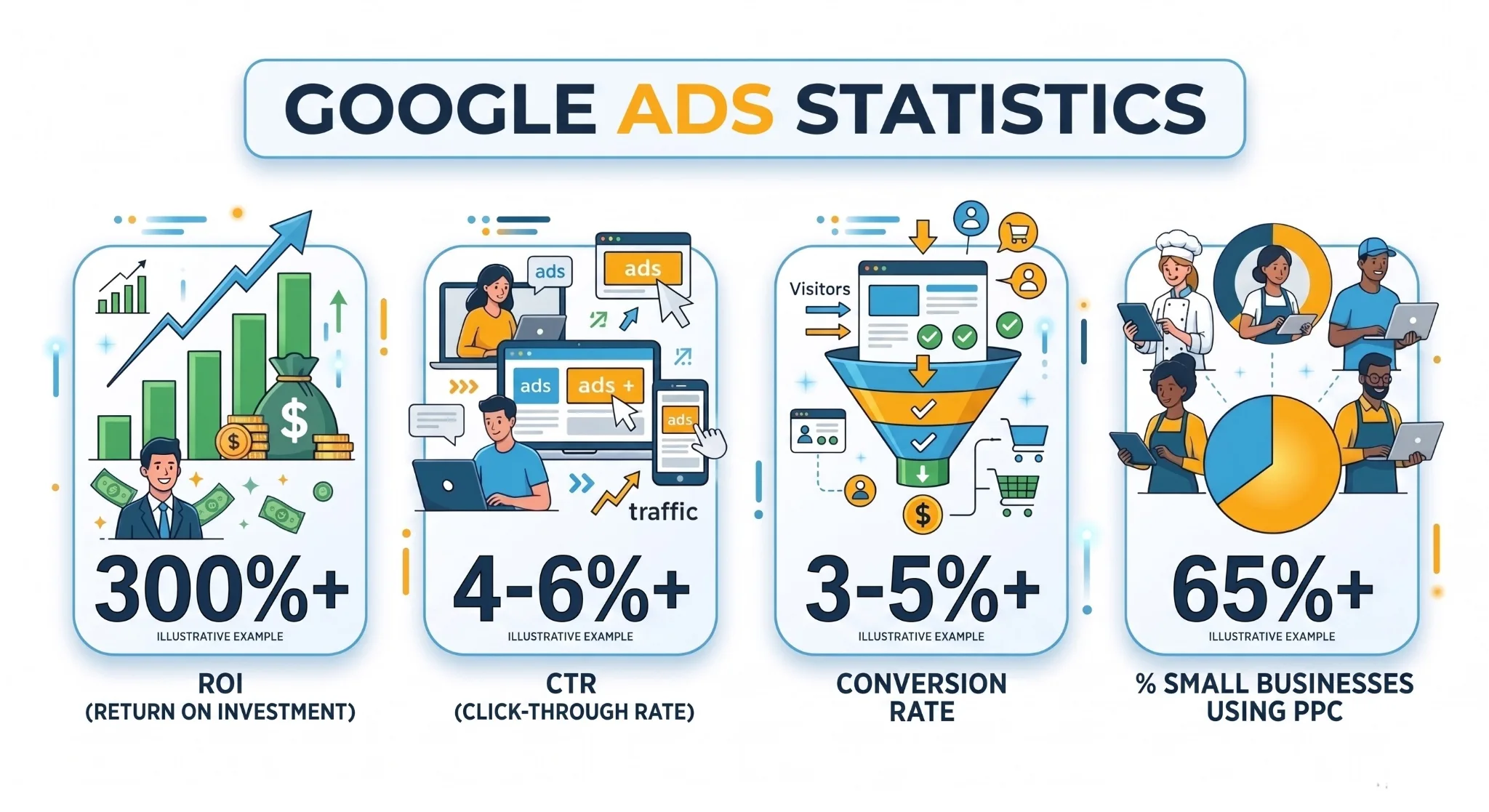
Google estimates that businesses generate an average of $2 in profit for every $1 spent on Google Ads a 200% return on investment (Source: Google Economic Impact Report). And that’s the conservative floor. When campaigns are well-optimized, the return compounds.
Across all industries, the average Google Ads conversion rate sits at 3–6% (Source: Web FX, 2025). The average click-through rate for the top-ranking ad is 7.94%. Those aren’t vanity metrics they translate directly into leads and sales.
2. You Reach Buyers, Not Just Browsers
Here’s what most people miss about Google Ads vs. social media ads: intent.
When someone sees your Facebook ad, they weren’t looking for you. They were scrolling through photos of their cousin’s dog. You interrupted their day.
When someone clicks your Google Ad, they typed “best digital marketing agency in Bangladesh” into the search bar. They were already looking. That’s an enormous difference in buying intent. People who click paid search ads are 50% more likely to purchase compared to organic visitors (Source: Demand Sage).
3. More Than 65% of SMBs Are Already Using It
Around 65% of small and mid-sized businesses already run PPC campaigns (Source: Web FX, 2025). If your competitors are on Google Ads and you’re not, they’re capturing the customers who should be finding you first.
4. Brand Awareness Even Without Clicks
Even when someone doesn’t click your ad, they see your business name at the top of Google. Paid ads can increase brand awareness by as much as 33% (Source: Web FX). For a small business trying to build a local reputation, that visibility matters.
5. You Control Every Dollar
Unlike a print ad or a radio spot, Google Ads lets you set a precise daily budget. You can pause a campaign in one click, redirect budget to better-performing ads, and see exactly which keywords are driving results. That level of control is something traditional advertising never offered small businesses.
How Much Does Google Ads Cost for a Small Business?
This is the question I hear most. And the honest answer is: it depends on your industry and goals, but there’s a range you can work with.
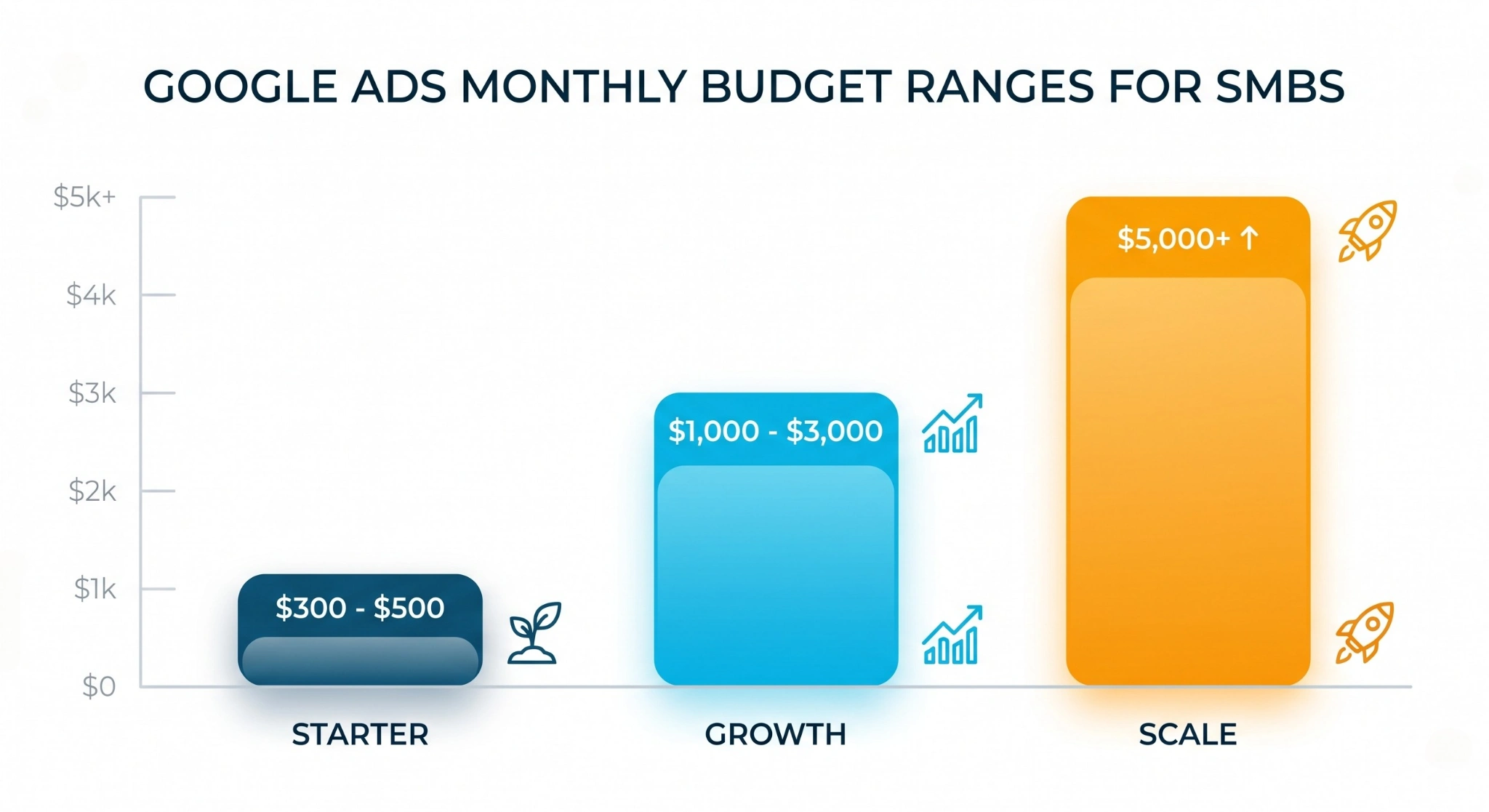
The typical small business spends $100–$10,000 per month on Google Ads (Source: WebFX, 2025). That range sounds huge because budgets vary wildly by industry. A local bakery and a personal injury law firm are playing completely different games.
For most small businesses starting out, a realistic budget is $500–$2,000 per month. Many agencies suggest starting no lower than $1,000 per month below that, you don’t generate enough data to optimize effectively.
Here are the core cost metrics:
- Average CPC (Cost Per Click) on Search Network: $2.69 (Source: StatsUp/Analyzify, 2025)
- Average CPC across all industries: $4.22 (Source: WeAreTenet, 2025)
- Average Cost Per Lead (all industries): $70.11 (Source: WordStream, 2025)
- Professional PPC management: $501–$3,000/month (Source: WebFX, 2025)
The key to making your budget work isn’t spending more it’s spending smarter. Negative keywords (filtering out irrelevant searches), tight geo-targeting, and landing page optimization can dramatically reduce your cost per lead.
Google Ads vs. Organic SEO: Which One Wins?
This is actually the wrong question. They’re not competitors they’re partners. But if you need to choose one to start with, here’s the reality.
SEO takes time. Building enough domain authority to rank on page one for competitive keywords takes months, sometimes longer than a year. If you’re launching a new business or entering a new market, waiting for organic rankings isn’t a strategy.
Google Ads gives you instant placement. You can be on page one of Google tomorrow. That matters when you need leads now, not in 18 months.
That said, organic SEO has zero cost per click once you rank. Long-term, a business with strong SEO and a well-run Google Ads campaign is unstoppable. Google Ads captures the immediate buyers. SEO builds long-term authority. Both feed your pipeline from different angles.
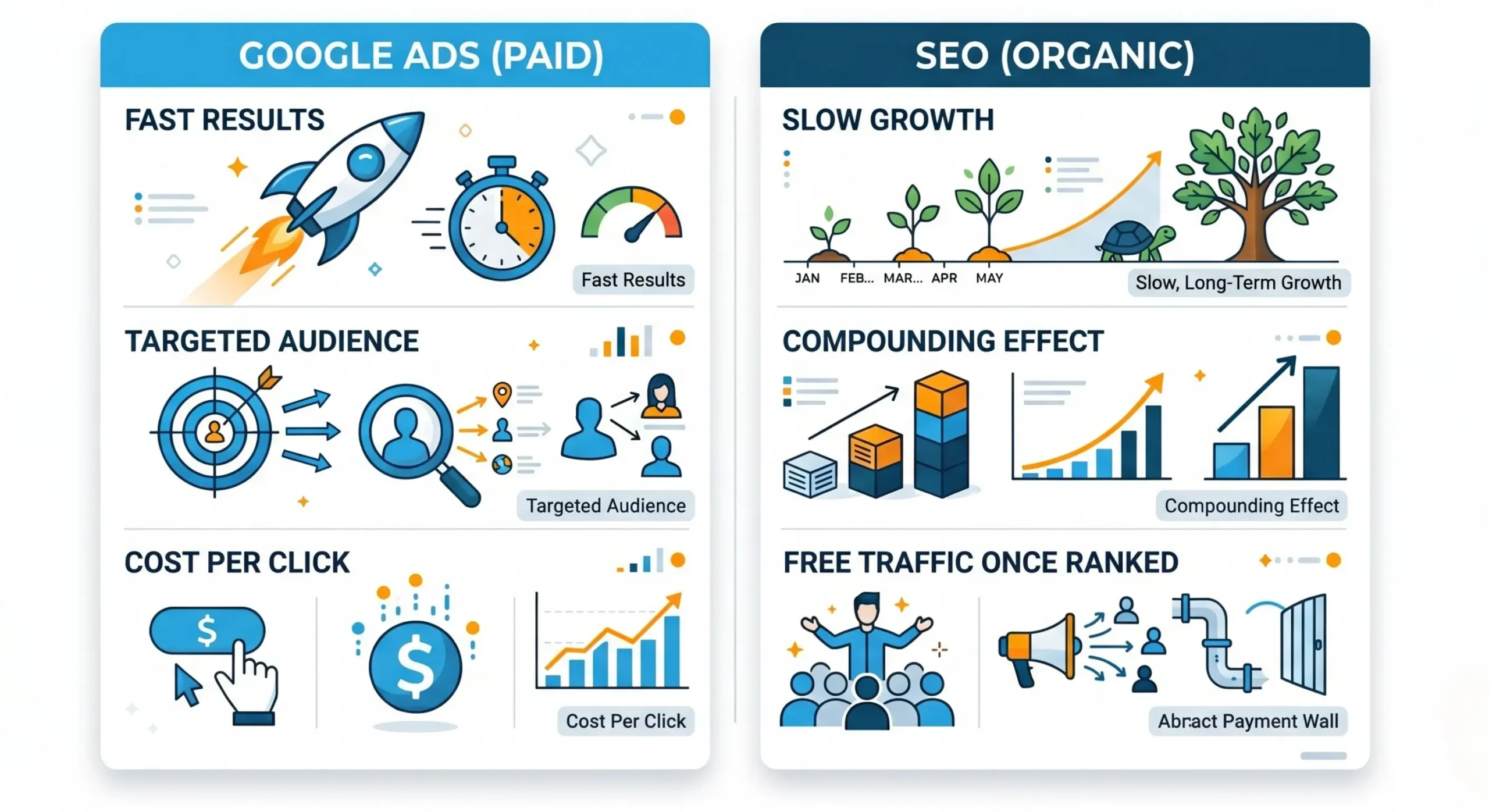
I’ve seen clients who paused their Google Ads once their SEO started working and their lead flow dropped immediately. Don’t treat it as either/or. Think of Google Ads as your engine while SEO builds the highway.
Common Mistakes Small Businesses Make with Google Ads.
I’ve worked with enough small business owners to know where the money disappears. Here are the most expensive errors:
1. Targeting keywords that are too broad Bidding on “marketing” instead of “digital marketing agency in Bangladesh” burns budget on irrelevant clicks from people who weren’t going to buy.
2. Ignoring negative keywords Not adding negative keywords means your ad shows for searches like “Google Ads free tutorial” when you want buyers, not students.
3. Sending traffic to the homepage Your homepage is designed for everyone. Your landing page should be designed for one specific offer. Sending paid traffic to your homepage tanks your conversion rate.
4. Setting it and forgetting it Google Ads is not a “set up once” platform. Without weekly monitoring and optimization, campaigns drift, Quality Scores drop, and costs creep up.
5. Giving up too early Most campaigns take 4–6 weeks to find their footing as Google’s algorithm optimizes your bids and audiences. Pulling the plug after two weeks means you’ll never know what could have worked.
If you’re not confident running campaigns yourself or you don’t have time to monitor them properly working with a specialist like Dream BD Agency can save you from these costly mistakes and get your campaigns performing faster.
Google Ads vs. Other Advertising Channels
| Channel | Time to results | Cost control | Intent level | Measurability | Best for |
|---|---|---|---|---|---|
| Google Ads | Immediate (days) | High | Very high | Excellent | Lead gen, e-commerce, local services |
| Facebook / Instagram | Fast (1–2 weeks) | High | Medium | Good | Brand awareness, retargeting |
| SEO (Organic) | Slow (6–18 months) | Time only | High | Moderate | Long-term traffic |
| Print / Billboard | Immediate | Low | Low | Poor | Local brand awareness |
| Email Marketing | Fast | Low cost | High | Good | Retention, upsells |
| YouTube Ads | Fast | High | Medium | Good | Brand building, video products |
WHY YOU CAN TRUST THIS GUIDE ?
This article is built on verified, publicly available data from industry sources including Google’s own Economic Impact methodology, WordStream’s annual benchmark report (based on 16,000+ real campaigns analyzed from April 2024 to March 2025), WebFX, DemandSage, and StatsUp/Analyzify.
Every statistic cited here is traceable to its original source. Nothing is estimated or invented.
Dream BD Agency is a results-focused digital marketing agency with hands-on experience managing Google Ads campaigns for small and medium businesses. Our approach is data-driven: we build campaigns around your actual customer value, not vanity metrics, and we optimize based on what moves revenue.
If you want a second opinion on your current campaigns or want to launch your first one reach out to our team. We’ll tell you honestly what’s working and what isn’t.
FAQ SECTION (People Also Ask)
1. Is Google Ads worth it for small businesses?
Yes, For most small businesses, Google Ads delivers measurable ROI faster than any other digital channel. On average, businesses earn $2 for every $1 spent. The key is proper targeting, a realistic budget, and consistent optimization. With a focused campaign, even a modest spend of $500–$1,000/month can generate a strong flow of qualified leads.
2. How much should a small business spend on Google Ads per month?
Most small businesses start with $500–$2,000/month. The sweet spot for generating enough data to optimize is typically $1,000+/month. The right number depends on your industry, average customer value, and how competitive your local market is. Start with a test budget and scale based on what converts.
3. What is the average ROI for Google Ads?
Google’s own methodology estimates businesses earn $2 in profit for every $1 spent in Google Ads a 200% ROI as a conservative baseline. Well-optimized campaigns in high-value industries often outperform this significantly. The average conversion rate across all industries is 3–6%, with some sectors like legal services converting above 6%.
4. How long does it take to see results from Google Ads?
You can start receiving traffic within hours of launching a campaign. However, meaningful optimization where Google’s algorithm has enough conversion data to improve performance typically takes 4–6 weeks. Don’t judge a campaign’s potential in the first two weeks.
5. What’s the difference between Google Ads and SEO?
Google Ads are paid placements that appear immediately at the top of search results. You pay per click. SEO is the process of earning unpaid (organic) rankings over time through content, backlinks, and technical optimization. Google Ads gives instant visibility; SEO builds long-term sustainable traffic. Most successful small businesses invest in both.
6. Can I run Google Ads myself, or do I need an agency?
You can manage Google Ads yourself, and Google provides tools to help beginners. However, without experience, it’s easy to waste budget on broad keywords, poor targeting, and ineffective ad copy. Many small businesses find that a professional agency pays for itself by reducing wasted spend and improving conversion rates faster than they’d achieve alone.
7. What type of Google Ads works best for small businesses?
For most small businesses, Search Ads are the best starting point they target people actively searching for your product or service. Local Service Ads work well for service-based businesses (plumbers, cleaners, clinics). Shopping Ads are essential for E-commerce. Once you have a baseline of traffic, Remarketing (retargeting past visitors) adds a powerful second layer.
CONCLUSION:
Here are the three things every small business owner should walk away knowing:
First, Google Ads puts your business in front of people who are already looking for what you sell no interruption, pure intent. Second, it’s measurable in ways that print, radio, and even most social media advertising can never match. You know exactly what every lead cost you. Third, the average return is $2 for every $1 spent, and with proper management, that number climbs.
The businesses that grow fastest aren’t the ones waiting to be discovered. They’re the ones showing up at the top of Google when their customers are ready to buy.
If you’re ready to launch your first Google Ads campaign or finally make an existing one profitable Dream BD Agency is here to help. We build campaigns around your real business goals, not just clicks.